
Geopolitical uncertainty is changing how companies make decisions
Insights|October 28, 2026
A disruption far from a company’s home market can quickly become a business problem. Trade restrictions may affect a supplier, an energy price increase can change the economics of a long-term contract, and a sudden conflict may force a company to reconsider where it operates. For boards and management, understanding those connections has become part of running the business.
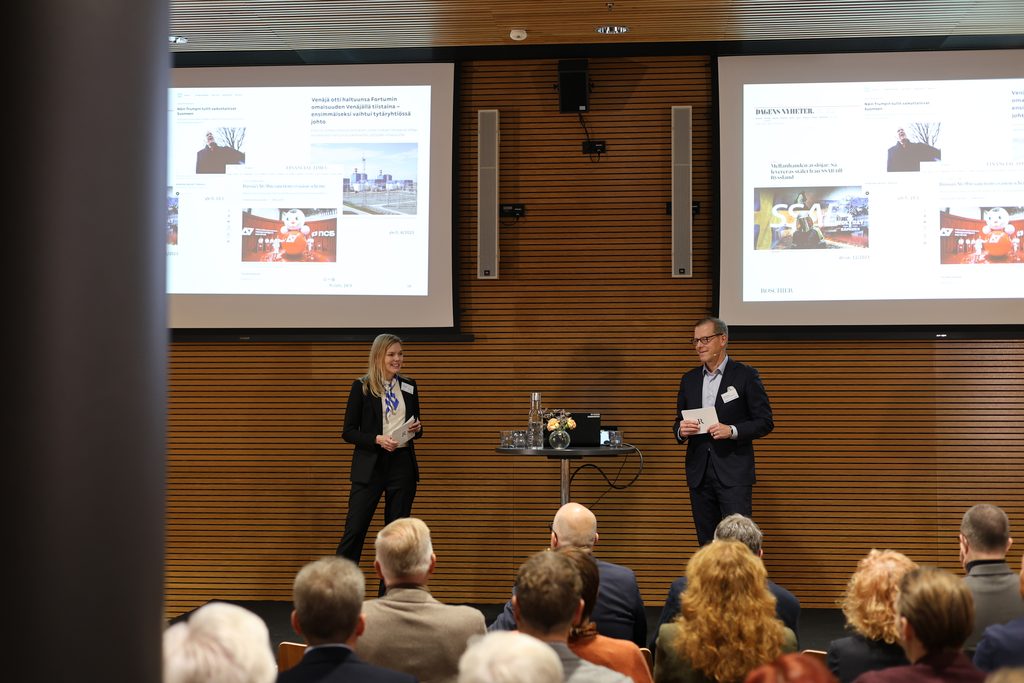
These questions were discussed at a recent event organized by Roschier, Boardman Advisors, and Miltton. Roschier Partners Jouni Salmi and Paula Airas contributed an advisor’s perspective on how companies respond to geopolitical change and what it means for investment and decision-making.
Much of the challenge lies in recognizing risks before they become urgent. The discussion distinguished between “black swans,” genuinely unexpected events with far-reaching consequences, and “black elephants,” threats that are known but remain unaddressed. A warning can be easy to set aside when its implications feel distant or the cost of preparing is immediate.
Companies cannot prepare for every possibility. They can, however, look more closely at the assumptions behind their plans. A supplier that has always been reliable may depend on a vulnerable shipping route. A contract intended to provide stability may become a financial burden if the market changes significantly. Understanding those dependencies makes it easier to decide where preparation is worth the investment.
From an immediate crisis to an ongoing business concern
The first response to a crisis often focuses on keeping operations running. Companies may need to find alternative suppliers or resolve an urgent sanctions question. Some decisions also involve the safety of employees, leaving little time to gather information before acting.
The work continues after the immediate situation has passed. Companies that have left a market may still face investigations into earlier activities or questions about where their products have ended up. Compliance requires sustained attention, even when new rules are being introduced less frequently.
This is where geopolitical risk becomes a strategic concern. It affects the markets a company chooses, the way it finances its operations, and the commitments it is prepared to make. Considering alternative scenarios helps management assess how a decision would hold up if conditions changed.
The cost of waiting
Uncertainty also makes major investments and acquisitions harder to approve. Postponing a decision can seem sensible while prices, financing conditions, or political developments remain unsettled. Sometimes it is.
But delay has consequences of its own. A company may miss an opportunity or hold back development that its business needs. Boards therefore need to examine the implications of waiting as carefully as the risks of proceeding. Complete certainty is unlikely to arrive.
There are also opportunities within the changes underway. Finland’s NATO membership has strengthened confidence in its position as an investment destination, while the green transition offers scope to reduce dependence on fossil energy and diversify energy production. Attracting investment still requires work, particularly as Finland competes with other Nordic countries.
Advice that helps companies act
For advisors such as Jouni and Paula, these situations call for a close understanding of the business as well as the law. Management needs to know which options are available and what each would mean in practice. Under time pressure, advice must be clear enough to support a decision with the information at hand.
A well-considered decision may still carry risk. The aim is to understand that risk, document the reasoning, and give the company a workable way forward. Preparing before a crisis makes this easier. It also helps boards distinguish between a sound reason to wait and uncertainty that the business will need to learn to work with.