What would help more companies grow in Sweden? Perspectives from Dahlgren Capital’s Kapitalmarknadsdagen
Insights|October 21, 2026
Raising capital can influence where a young company establishes itself and where it grows. For Sweden, the challenge is to give businesses access to larger investments while making it practical to continue developing their operations here.
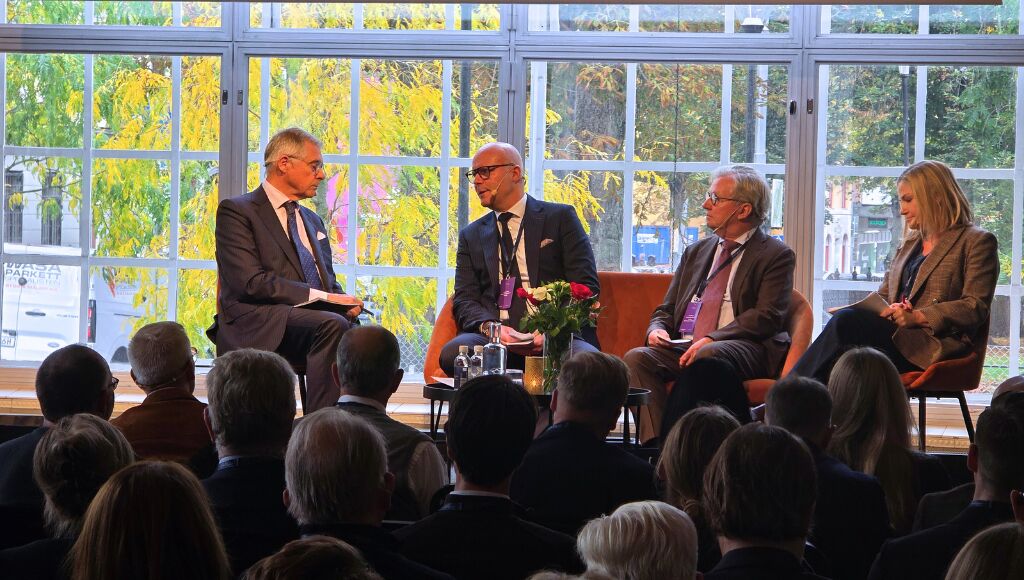
At the recent Dahlgren Capital’s Kapitalmarknadsdagen, our Group Managing Partner Johan Sidklev joined a discussion about financing growing companies in Sweden and Europe. Economist Klas Eklund moderated the panel, which examined the obstacles facing businesses and possible measures to address them.
Decisions start before a listing
Sweden’s position as a startup country does not mean companies will necessarily choose a Swedish corporate structure when preparing for expansion.
“Even when we speak to some of our most successful startups that are not yet listed, they choose not to register in Sweden, even at an early stage,” Johan said.
He described how a Swedish parent company can be seen as impractical when attracting investors. That makes the choice of jurisdiction an issue well before a business considers going public.
Sweden nevertheless has a strong foundation. Johan pointed to its pension and savings systems, broad investor base and accessible share trading platforms, together with an active private equity sector.
“But more clearly needs to be done, particularly for growth companies,” he said.
Why European funds struggle to grow
Isabella de Feudis, CEO of the Swedish Private Equity & Venture Capital Association (SVCA), explained a financing problem that affects the size of investments European funds can make.
“A large pension fund needs to invest quite a substantial amount in a venture capital fund for it to make sense and deliver returns. European venture capital funds are still quite small. They cannot grow because they are not getting those larger investments,” she said.
Smaller funds cannot always accommodate the commitments large institutional investors need to make. This restricts their access to capital and, in turn, their capacity to finance larger funding rounds. Isabella contrasted Europe’s more nationally focused funds with US funds that have more money available and greater industry specialization.
Could a common European framework help?
Differences between national company law systems were another focus of the discussion. Johan supported an optional common European framework that companies could choose instead of their national structure.
“I believe in an opt-in solution. When the market sees that something is better and offers a faster way forward, more companies will choose it,” Johan said.
He also emphasized the need for dispute resolution mechanisms and courts capable of handling cases under the common framework.
Pehr Wissén, of the Stockholm School of Economics and Swedish House of Finance, discussed the difficulty of reaching agreement on European reforms. An optional framework could allow progress without first resolving every difference between national systems.
“It is a faster way forward than trying to harmonize German, English, French and Italian legislation,” he said.
The ability to hire matters, too
Johan called for employee stock option rules to be better adapted to young companies with higher risk: “The purpose is to recruit and retain key people without necessarily having to pay high cash salaries, which is difficult at the beginning.”
He also raised the possibility of tax incentives that would make it easier for investors to reinvest proceeds in new businesses. His final recommendation concerned a different obstacle to recruitment: Stockholm’s housing market.
“People cannot afford to move here. We need a more carefully considered housing policy,” Johan said.
For a startup recruiting from outside the region, the cost of housing can prevent a prospective employee from accepting a job. Access to funding may allow a company to hire, but the people it needs must also be able to move there.