AI is challenging corporate boards too: “Change has to start with ourselves”
Insights|May 22, 2026
Artificial intelligence is no longer just an IT or innovation topic, but increasingly a leadership, governance, and boardroom issue. That was the central message at the AI in board work breakfast event, organized together with Directors’ Institute Finland (DIF), where the discussion focused less on hype and more on what AI means for companies, boards, and decision-making in practice.
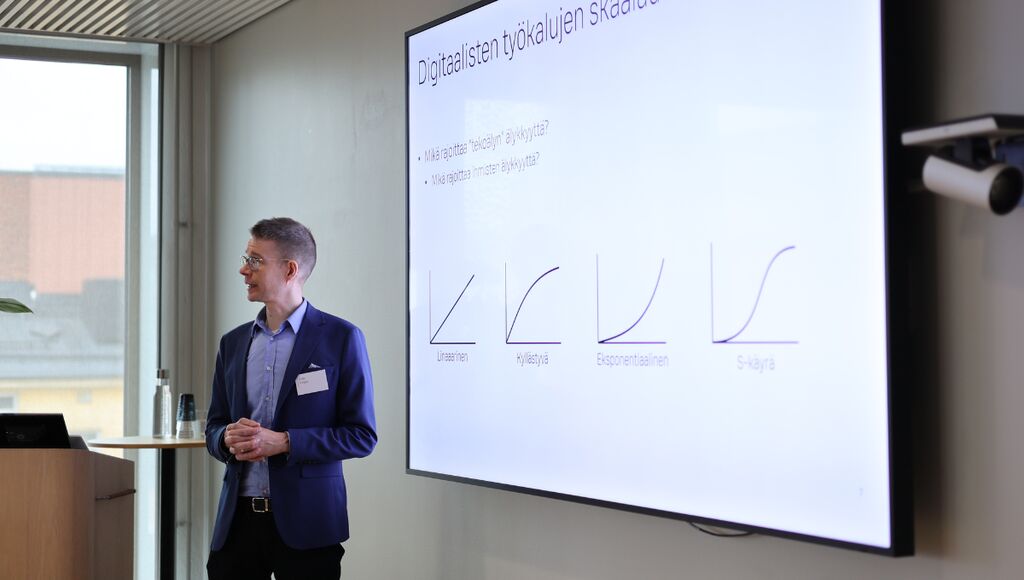
The speakers included Roschier partner Paula Airas, Vaisala Chairman Ville Voipio, and Stora Enso Chief HR and EVP, People and Legal, General Counsel Micaela Thorström. Together, their presentations combined regulation, board responsibility, organizational change, and practical business applications in a way that reflected how broad the AI discussion has become inside companies.
Governance and regulation move to the center of board discussions
Paula approached the topic through regulation and governance, saying that AI cannot be separated from cybersecurity, compliance, and corporate responsibility anymore. Boards are expected to understand what kinds of AI systems are used inside the company, how related risks are managed, and whether the organization has sufficient competence and oversight in place.
She outlined how rapidly the European regulatory landscape is evolving through frameworks such as the AI Act, GDPR, and cybersecurity legislation. According to Paula, companies now face growing expectations around AI literacy, governance structures, and risk management. At the same time, there is increasing pressure within Europe to simplify overlapping regulation to avoid slowing innovation and competitiveness. AI governance, she said, is becoming part of the board’s broader duty of care rather than a standalone compliance issue.
Organizations may need to rethink how they operate
Ville focused on what AI may ultimately mean for organizations themselves. He said that many companies are still treating AI as an add-on rather than a true transformation. Adding AI features to existing products or processes is not enough if the underlying organization remains unchanged.
According to Ville, the real shift begins when AI starts changing how decisions are made, how work is organized, and how companies operate internally. He described how development is rapidly moving from simple chatbots toward AI agents and eventually teams of agents that can analyze markets, monitor competition, support risk management, and assist leadership and boards in continuous decision-making.
One of the strongest themes in his presentation was the importance of data. Future AI systems rely heavily on centralized corporate knowledge and data repositories, where operational information, internal communication, business processes, and institutional knowledge are brought together into shared systems. While this creates major opportunities, it also creates equally large governance and cybersecurity challenges.
The broader message of Ville’s presentation was that the hardest part of the AI transition may not be the technology itself, but whether organizations and leadership teams can change fast enough. Boards face a difficult position, because many board members built their careers in a very different business environment, yet they are now expected to oversee technologies evolving faster than traditional corporate structures can realistically adapt.
From theory to measurable business impact
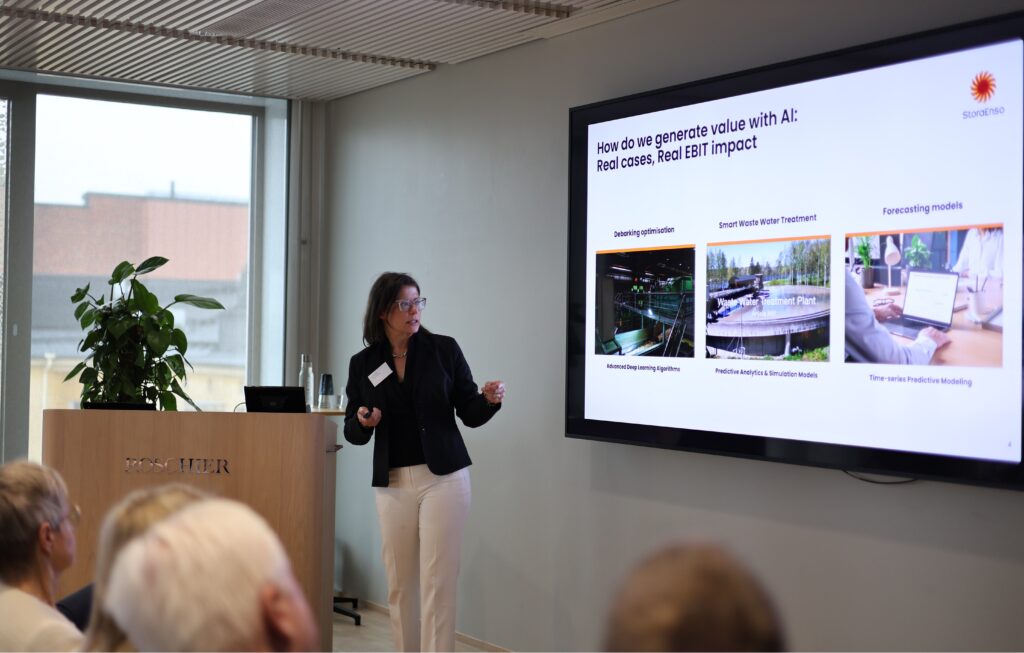
Micaela focused on practical implementation through concrete examples from Stora Enso. Rather than speaking in abstract terms, she showed how AI is already producing measurable business impact inside industrial operations.
One example involved computer vision systems used in wood debarking processes. AI-powered monitoring helps optimize production, reduce waste, and improve raw material efficiency. Another example focused on wastewater treatment, where AI continuously monitors chemical use, temperatures, and operational variables around the clock to optimize the process in real time.
Stora Enso is also using AI in financial forecasting, supply chain processes, and forestry operations. In forestry, AI systems analyze satellite and drone data to optimize harvesting and support biodiversity goals by identifying environmentally sensitive areas that should be protected.
Micaela emphasized that the company approaches AI primarily through business cases and measurable returns rather than through workforce reduction targets. The focus is on identifying where AI creates operational or financial value and then scaling successful solutions across the organization. According to her, AI projects at Stora Enso have already produced clear financial impact through improved efficiency, lower costs, and process optimization.
The human side of AI adoption
The discussion also focused heavily on how AI is changing professional work itself. Legal and HR functions were highlighted as examples where AI tools are already reducing time spent on repetitive work such as contract review, document analysis, patent drafting, and information retrieval. Tasks that previously took hours can now often be completed in a fraction of the time, allowing teams to focus more on strategic work.
At the same time, participants acknowledged that many open questions remain unresolved. Several audience comments focused on the human dimension of AI adoption: how companies handle employee concerns, how organizations preserve tacit knowledge, and what happens when AI systems become increasingly capable of replicating expertise that previously existed only inside individual employees’ heads.
One audience member raised the issue that companies often rely on experienced individuals who hold critical institutional knowledge that is not documented anywhere. The challenge, the discussion suggested, is how to transfer that knowledge into AI-supported systems without creating fear that employees themselves will become replaceable.
Responsibility remains with people
Another recurring topic was responsibility. Even if AI becomes deeply integrated into decision-making, speakers repeatedly emphasized that accountability remains with people. Boards and management teams cannot delegate responsibility to algorithms or AI agents, even if those systems increasingly influence decisions.
By the end of the event, the overall conclusion felt less like a technology forecast and more like a broader discussion about leadership and organizational transformation. AI is no longer a separate innovation initiative sitting on the sidelines. It is becoming embedded in governance, strategy, operations, and corporate culture.
For boards, the challenge is no longer whether AI matters. The challenge is whether leadership structures, governance models, and organizational culture are evolving quickly enough to keep up with it.
Related articles:
AI, law, and the next phase of enterprise software